This post was originally sent to my email subscribers on June 30, 2024. It is being reposted here to create a more easily searchable archive.
Hello, my lovely owls! I had to stop myself from opening this month’s newsletter with “Dearest gentle reader…” because I got into a bit of a Bridgerton kick this month (every time I think I’m out, they reel me back in). It’s not quite July yet in my time zone, but it is at least somewhere in the world, and I like to write to you on the weekends. It’s been a good month here at the Owl Knight… base? Nest? Let’s go with “nest”. I’ve been making lots of progress on things, even if it’s not necessarily the things I feel like I “should” be working on (the pleasures and pitfalls of answering only to myself).
Project Updates
Dollhouse Drama
My big effort on Dollhouse Drama this month has been writing the “example of play” text – the bit we put in RPG rulebooks where you make up some fake players and write dialogue like they’re talking to each other while playing the game. I’ll be perfectly honest: I expected to find this really hard. I don’t typically READ the “example of play” in most RPGs unless something is so poorly explained that I’m really confused about it. I skip it probably 95% of the time. So I went back and read the examples from some of my favorite games.
Some games put it as one big long section after all the rules are explained; others do it in little chunks and sections, with a chunk of example placed right after the relevant rule. I think I prefer the former, so I’m setting it up as one chapter that goes through everything, and I’ll have a sidebar with page references to any rules being used. I actually started finding it really fun to write once I got into it. And hopefully I’ll have done a good enough job that it will be useful to potential players.
Before the Season Ends
Picked up work on this one in earnest again this month, and I think I’m going to try to have this ready for Metatopia in the fall (is it silly to be thinking NOW about a convention 4 months away? Yes. Am I doing it anyway? Yes). BTSE is my token-based game about Regency-era debutantes enjoying their debut social season, exploring London and making friends. I’ve been refining some work I did last year with the token-based actions – the ones that are universal for everyone and the ones that are specific to each playbook AND the ones that are specific to traded tokens. I feel like I’m still not sure how to explain this game, but I’ll get there.
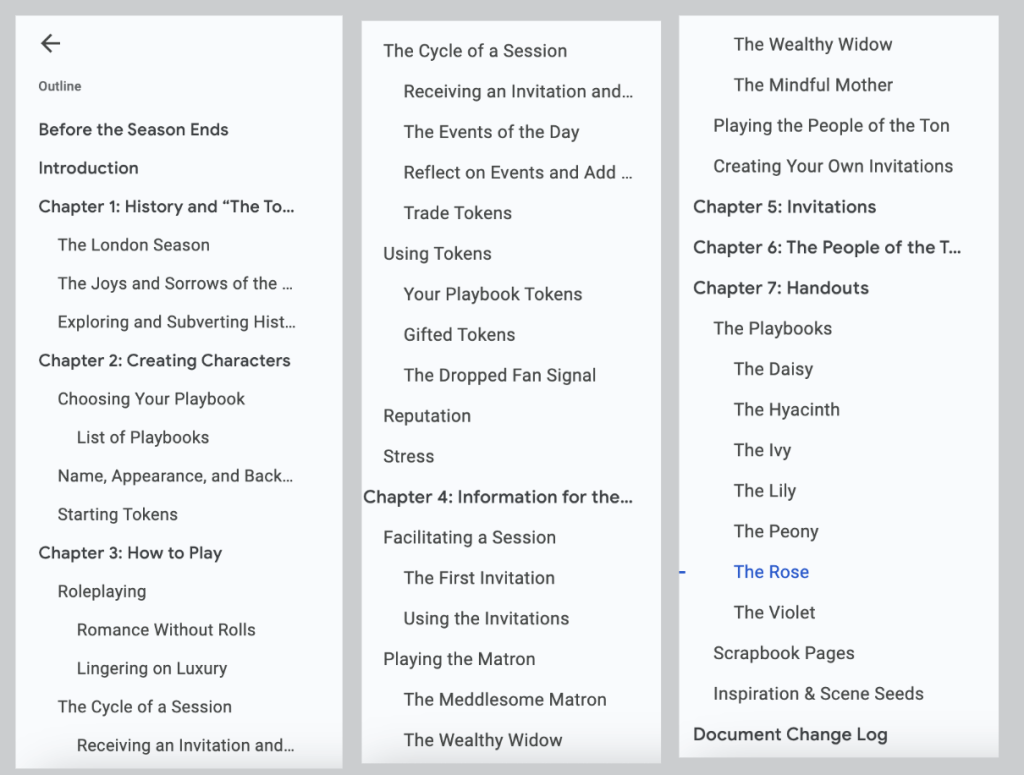
This one has been rewritten several times in the last 4.5 years because I keep scrapping it and starting over. I’m feeling good about it this time though, confident about what I want from it in a way I wasn’t before. Just over the last few years, I’ve learned so much more about both my own working process and also what I want from my work, you know? For example, I’ve learned that it works best for me if I outline the table of contents of the game first, and then tackle sections as they come together for me, rather than trying to work through the whole book from intro to conclusion in order. This is what that outline looks like for BTSE!
Diplomacy of Queens
I’ve also started doing some preliminary design work on The Diplomacy of Queens, my game about princesses and ladies being raised as wards of the Holy Roman Empress in the High Middle Ages, and then growing up and having to do politics against each other, with a lot of personal baggage (both this one and Before the Season Ends were alluded to in my May newsletter when I was talking about Castles in the Sky! Accidental inspiration to get my ass to work on these, maybe).
Specifically I’ve been working through the character creation process, which I see as being really fundamental to this game. I’m working on a character sheet in four quarters, basically: one part for who you are, and one part for where you’re from (which little duchy or province, etc.), which you choose and fill out first. Then we play through a little prologue scene, set in the childhood timeline of the game, with all the young girls meeting each other for the first time. And THEN we finish character creation, where as an adult, your husband and his homeland, your new home, are basically randomly dealt to you – you don’t get a say in those, even though they’re really impactful to who you become as an adult and what you can/cannot do in the game.
I worry a little bit about the friction of having basically half of character creation be something you don’t get to choose – it’s more like character discovery, perhaps. But I think it’s friction that reinforces the theme of the game, where these young women are basically sold into marriage by their fathers as part of treaties or land packages, and “love” and “choice” don’t really enter into the equation. It got me thinking about other games where choices are limited to certain areas (like a PbtA playbook, where you can choose the playbook and choose some of the specific moves, but other things are just inherent to that playbook). I think it’ll work to the game’s advantage, ultimately, but I do love to worry about things I don’t need to worry about.
Further Thoughts
The Price of Coal Commentary + Text-Only Edition
Recently, Possum Creek Games released a new PDF version of Wanderhome with commentary from members of the creative team, like a director’s or actor’s commentary track on the bonus features of a movie (this is part of the “Disc 2 Jam” on itchio, encouraging designers to do just that – create “bonus features” for TTRPGs). I found this so interesting, and I ended up doing a much closer read of the text of Wanderhome than I had previously done. I love thinking about and talking about other artists’ creative process, regardless of medium, but of course it’s especially interesting to me for the medium I work in too.
So I LOVED seeing this, and I was so inspired that I ended up doing a commentary edition of The Price of Coal. Of course, figuring out how to put this into the world also meant figuring out how to put out a text-only version of the game, mostly as a reference material for other designers, more than as an actually playable version. Maybe it’s optimistic of me, but I like to think of my game being an inspiration to some other up-and-coming game designer, as many others were (and still are) to me, so making the text of the game – with my notes on WHY certain things are the way they are – easily accessible is a big part of making that happen.
To that end, the text-only + commentary version of the game is available for free on itchio now. It is literally just a spreadsheet of each card’s text, with another column showing my thoughts on each card. It’s not pretty, it’s not fancy, but it is a free reference material that I’m really happy to have out there!
Creative Inspiration in Different Media
There’s a conversation going on right now in some video game spaces that I’m tangential to, about when your only inspiration for your games is other video games vs seeking inspiration in other media. I don’t have any stake in video games (I don’t even play them that much), but it’s always interesting to see what’s going on over there, because I do think of them as kind of a sister-medium to tabletop games. I kind of likened this to something I’ve seen in a lot of prose fiction spaces about reading within your genre vs reading outside of it.
You, as a creator, have to find the right balance. I don’t think it’s good, creatively, to do only one or the other. If you, as a fantasy author, only read fantasy novels, it can be hard to find new things to bring to the table. But if you, my hypothetical fantasy author, NEVER read other people’s fantasy novels, you don’t know what’s going on in your own backyard and you’re missing the innovations of your peers.
I think the discussed video game issue is less of an issue in TTRPGs though, for the opposite reason, really: the last 10ish years of TTRPGs have been a LOT of genre emulation. A lot of the big RPGs you can name from this time have one or two very clear and specific influences (whether they’re movies or video games or what have you), and the game is meant to deliver on the idea of “this is the TTRPG of the thing you already know” (obviously I’m generalizing quite a bit here, and there’s lots of games that don’t fall into that category, but there’s LOTS that do). Really the only specific case I can think of where TTRPGs are using themselves, their own medium, as inspiration is like the OSR (Old School Revival/Renaissance) realm, where new games are created specifically to evoke the feel of older games. That does go for more of the “trad game” realm than just OSR, but OSR is – by nature – the most explicit about it.
I have never been shy about my influences on my work – it’s a lot of books and a lot of movies, and honestly very few games, in terms of the initial idea (the mechanical inspirations come from all kinds of games). I don’t know if that’s good or bad, or if it CAN be good or bad (I think it’s probably just neutral). Maybe it just comes down to the fact that my initial idea never has any mechanics attached, and is just a vibe that I want to evoke. I will say that in recent years, much more of my inspiration has come from reading nonfiction – it turns out the real world is a weird and wonderful place, and there’s so much to pull from that can create rich and evocative game experiences without being beholden to someone else’s idea of an IP or a genre.
I’ll also say that I don’t typically seek out media with the intent of “I think this will inspire me to create something else”, and I don’t think chasing that feeling is useful. What I think is most important is just generally being curious and open to things, and seeking out things that satisfy your curiosity. I have been around for 20 years of talk in creative writing spaces about “where do ideas come from”, and I can’t answer that with any generality or usefulness to others. But for me, my ideas come from a feeling of curiosity, and a willingness to seek out answers to that curiosity, and an openness to finding more questions when I get there.
As a related segue, and to answer a friend’s suggestion (hi Lee!), here’s my current shelf of books to read. Or at least, it was as of a couple months ago (when I decided to move most of my unread books into my bedroom, where I do most of my reading, and move all my already-read books down into our “library” (the dining room)); now I’ve read about 10 or so of these (there’s also a couple “hey I haven’t read that in 10-15 years, I should give it another go”). I keep saying that I can’t buy any more books until I’ve read all of these, but let’s be honest: that simply is not going to happen, because I do not have that kind of self-control.
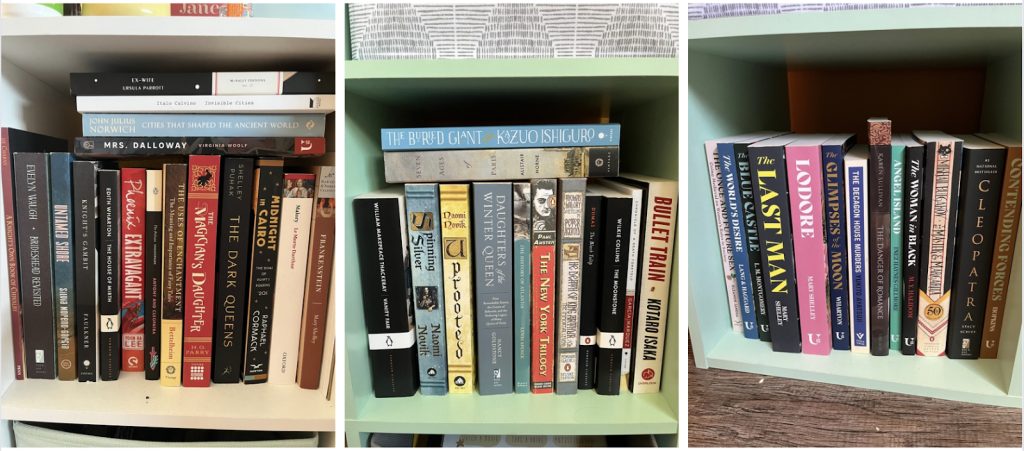
But as one example, I didn’t pick up that biography of Cleopatra with the intent of being inspired by it; I didn’t say “I think this will give me ideas for a game”. I remembered loving a book about Cleopatra as a little girl, and I saw that Dune director Denis Villeneuve is working on a Cleopatra movie, and I thought “huh, I’d like to know more about her”, so I picked that up to satisfy that curiosity. And sure enough, while I was reading, I had a game idea that I may or may not ever complete – but having those notes in my files now is something I can always come back to, whether for that concept or for another.
At any rate, I hate the idea of telling others what’s “important” to read (the canon is fake! There are no rules! Read what you want!), but I have found it important for me lately to keep a good balance of classics and more contemporary fiction and nonfiction. Admittedly, the classics and the nonfiction have been much more fulfilling and inspiring to me, and I feel like a stodgy old coot when I say things like this. Blah blah blah enriching reading, reading for betterment, not just reading cheap trash. I won’t tell anyone else what to do! I can only tell you what’s working for me! Or else I’m going to turn into Mr. Collins, telling every young lady to read Fordyce’s Sermons, and then I need you all to give me a swirly like the insufferable dweeb I am.
Hidden Information vs Open Secrets
I have always loved the idea of secrets. Not just in games, but in life (although this will mostly apply to games). In the 7th grade, one of my best friends told me that she felt so comfortable telling me anything at all because she knew I was so good at keeping secrets, and it went straight to my head for the rest of my life (I AM good at keeping secrets). I am not good at having my OWN secrets though; I have always been something of an open book with regards to my own life, and I think this is a funny contrast. As a teen girl with the most dire, world-ending crushes, I would do ANYTHING to keep it a secret from the subject of the crush… but I had to tell ALL my friends about it or I would explode.
Secrets are exciting. They’re an instant injection of drama into any narrative. Someone knows something that no one else knows, and knowledge is power. Someone is trying to find something out, and maybe they don’t even know yet WHAT they’re trying to find out, but they know there’s information they don’t have and that they want. So it’s no wonder that I love the idea of incorporating secrets into games. I have often suggested that when you’re trying to come up with a compelling character in a game, give them a goal and a secret, and turn them loose.
But I’ve found over the years that there’s kind of two schools of thought there. One thought is that a character’s secrets should be kept secret from the other players as well; the other is that the character’s secrets should be open to all the players, so everyone can collaboratively tell the best story around that secret, with intent. Myself, I’ve gone back and forth, and I see the merit in both, depending on the game and the players involved.
Some of my favorite game moments have involved working with a GM to craft a secret about my character, and then the joy of revealing that secret to the other players at the table. It’s delicious. And I love having a secret revealed to me just as much; it feels sincerely thrilling. And often, I find that the real juice of RPGs is in the happy accidents that come from collaborating with others; things that happen unplanned and with no one’s real intent behind them.
But there’s real joy to be had in intentionally poking around an open secret, too. If my character has a secret identity, and other players at the table know about it – even if their characters don’t – they can also craft scenes to feed into that, where their characters unknowingly hint at the truth, or come close to discovery, or comically jump to the wrong conclusion. It’s a kind of “meta-gaming”, a term that’s so fraught that I’m hesitant to use it, but it is, quite literally, the use of player-knowledge to supplement character-knowledge. It’s dramatic irony, which I always love.
It’s one of those things where people in this space love to say “this is the right way to do things”, like some kind of universal rule, which I don’t really think exist in TTRPGs. I think it’s so dependent on the game and the players and the characters and what the secret IS, that I can’t imagine one general “you must keep secrets from fellow players” OR “you must reveal everything to everyone” could ever work.
Anyway, I’ve been thinking about this in part just because it came up in conversation with someone recently, and in part because one of my in-progress games involves characters each having secret objectives they’re trying to accomplish. I am trying to figure out to what extent I want that information to be public to everyone else at the table. I don’t have answers yet, but this is one of those fun little conundrums to puzzle out – not a universal answer, but what answer is right for this specific game.
Games I’m Into
Cypher System First Responders
A few years back (and it feels wild that it was even that long ago), one of my friends ran a firefighting-themed D&D campaign for our group, where we played characters starting up the first fire brigade in a town, basically inventing the very concept of organized firefighting in this setting. We had an absolute blast with it, and to this day I would say that it’s my favorite D&D game I’ve ever played in. I played a firbolg (basically a part-giant) paladin; my job on the crew was to rescue people stuck in these buildings and carry them to safety, so I was big and strong and had the paladin’s limited healing ability.
We recently decided to do a new arc of that campaign, but recreating those same characters in the Cypher system, to take advantage of their First Responders book. First Responders is a supplement book with rules for – as you might guess by the name – disaster response. I’m so happy this book exists, because it’s a space that I feel is really ripe for non-combat situations that are still life-or-death stakes. Many years ago I tried to run a Blue Rose campaign where I basically had the player characters being part of magical FEMA, and it didn’t quite work out how I envisioned it at the time, but I was still compelled by the concept.
This was also a really interesting experiment for me, in lifting a pre-existing character from one system and recreating her in another, which I actually hadn’t really done before! Cypher is really broad (it’s the underlying system from fantasy game Numenera, but adapted to be setting-neutral), so I think there were actually lots of different approaches I could have taken, and not just the one I did. Cypher character creation is structured like a sentence: “[Name] is a [Descriptor][Type] who [Focus Verb].” So Holly, my beloved paladin, is now not just a paladin, she is “an Honorable Warrior who Shuts Death’s Door”. And each component of that (“honorable”, “warrior”, and “shuts death’s door”) drives a different aspect of her skills and abilities. So I’m really excited to give this a try and get back into an old campaign in a new way.
Inevitable
I recently received the physical copy of Inevitable, an RPG I had backed during its crowdfunding campaign (the PDFs had been out for a while, but lately I’ve been waiting for the physical copies of things). Inevitable is one of a small handful of games that sounded just ridiculously tailor-made for me, and I was really pleased to read through the book and see I was right – I love it. This is one of two games ever that I have described to my boyfriend and he’s said “did you write this and then fall into a coma and forget about it?” I’m obsessed. I can’t wait to bring it to the table.
Inevitable is described as “an Arthurian Western roleplaying game where your party of disastrously sad cowboy knights fail to stop the apocalypse.” Uhhhh YES??? That’s checking all the boxes for me. I love things that are Arthurian (as we discussed in depth last month), I love things that are disastrously sad, and I love stories about failure. It’s been a WHILE since I received a new game that I felt such an urgent need to run. I’m thrilled. And I am so sorry to whichever one of my regular game groups I will be forcing this on sooner or later.
Closing Notes
So, speaking of books inspiring things, I happened to read a couple things close together that ended up fusing in my brain into a fun new idea (that, again, may or may not ever happen – ideas are like that – so I won’t get too into the idea itself).
Back to back, I read The Art Thief by Michael Finkel (which was recommended to me by my mom!) then I read The Art of Rivalry by Sebastian Smee, and I recommend them both very highly, as interesting looks at some very specific types of people. A happy accident of reading one book and then looking at “well what’s the alphabetically closest thing on my e-reader, I’ll read that next.”
And then I wanted to feed this idea, you know, really give it some good fertilizer, so I also watched Ridley Scott’s directorial debut, The Duellists, from 1977 (which was also interesting from the perspective of having watched his 2021 movie The Last Duel, which treads a little bit of the same ground, with a higher budget and 40 years of experience under his belt). And I might rewatch Amadeus for good measure (or just because you can never go wrong with Amadeus).
That’s all for this month, folks! Thanks as always for reading!
 Owl Knight Games