
Hello, my lovely owl friends! September is my favorite month of the year. I love the transition from summer to fall, I love the whole back-to-school vibe (even if I haven’t been in school for a very long time), and it’s also my birthday month. In fact, I’m even having a birthday sale on all my games this month – everything is 32% off, or you can get everything in a $32 bundle, since I am turning 32 this year. Definitely check that out!
I also have our monthly Dollhouse Drama playset pack, keeping that train rolling. August’s theme was Voyages and Expeditions, so this expansion pack has a cool besties road trip, a Star Trek adjacent trip to outer space as part of the Space Cadets, and a pulpy action-adventure trip to an island to rescue lost treasure before the volcano explodes! We’re always expanding the dollhouse over here, so be sure to take a look at that on itchio or DTRPG!
Project Updates
Blood of the Covenant
When I did my little goal progress check-in earlier this year, I refocused a little bit to prioritize getting the ashcan version of Blood of the Covenant out, which is something I really want to make sure I do before the end of the year. Part of it is just that I have had this game in progress for SO LONG (it’s my oldest project at this point) that I feel like I’m at a “shit or get off the pot” moment with it, like if I get this ashcan version out, and I decide I’m just done with it, that can be it. Or I can give it a year or two before I try to do anything with it at that point. I can’t figure out what I want to do with it until that point, I think.
I think the danger of this being such an old project, that’s been completely overhauled a few times over the last… 8 years, is that it’s SO hard for me to feel like I have a clear vision of it. If I picked up this same concept today, is the way I started this project then the way I would do it now? Am I overly beholden to that original vision? Am I saying what I want to say? It’s become impossible to not feel like all of those questions are wrapped up in the time that’s elapsed, and maybe it’ll be clearer if I just get it off my desk. So hopefully, the process of getting the rest of it written to a usable state for others helps me get answers and clarify if I want to keep going with it, or if maybe I need a total blank slate to say what I originally wanted to say with it.
To that end, I’ve done a lot of writing for it this month; it’s kind of taken the place of Dollhouse Drama as my “warm-up work” when I have working sessions. I’ll spend the first 20-30 minutes just writing something for it, where the design is already done, and it’s just a matter of putting words on the page. Just something where I have a clearer picture of what’s needed and how to get there, to ease in before I jump right into design-heavy work.
Pax Deorum and Champions of the Crystal Crown
Most of the rest of my time this month has gone to getting these two games ready for Metatopia. It’s funny how I started really winnowing down what I wanted to do with these, in terms of playtest-readiness for the big playtesting event like six months early (I started in May, Metatopia isn’t until November), and at the time I was like “wow, I’m so ahead, I’m so early, this is great” but now time is ticking down and I’m looking at what’s left to do like “oh… this is a lot actually.”
For Pax Deorum, I did an unusual number of prototype tests this month, more than I’ve done for anything else. This game is a bit more numerically driven than other things I’ve done, and I simply do not have a mind for math where I could envision the pacing of the game or the timing of certain events without “playing” it out through a prototype. I’ll talk about this more in a later section of this newsletter, actually!
For Champions, this was a lot of time defining what the different character actions are and what the different scene framings are. The actions are a little Blades-y, where they’re a single verb, but they’re different for each playbook, and so even though there’s thematic overlap between all the different archetypes, there was a lot of making sure that everyone’s actions feel unique and special. These are thesaurus days, where I’m really checking the strength of each word choice, especially when I want to convey a lot in a single word. Is it too similar for the Thief to be able to “Appraise” and the Herbalist to be able to “Identify”? Lots of little judgment calls like that.
Other Thoughts
Why Don’t People Play More Historical RPGs?
The other day, someone on bluesky asked why it’s so hard to pitch people on historical RPGs. As you can imagine, this is something I have a lot of thoughts about. Some of those thoughts, I was worried would be misconstrued in the micro-post social media format, or might just come across as mean anyway, so I covered some initial basics over there and then thought I would bring the rest of it back here, where I can make it really long and also know that everyone here signed up for me rambling about niche subjects.
To recap the basics, if you don’t want to go read the thread, here’s some things that I heard from people when I was working on The Price of Coal that are common explanations for why this was a hard sell:
- No matter how much I assured them that they didn’t need to know anything about the history or the region or the time period, that the game setup covered ALL the information they would need, they did not believe me. There was a very firm insistence that some people gave me that they couldn’t play without having some kind of background knowledge for the subject.
- Related, people don’t want to “get things wrong” or “be corrected” when they’re in a mental mode of play, when it’s playtime. When we’re all just making things up, no one can actually tell them they’re wrong (we’ll set aside for the moment that this is already rendered untrue if you’re playing something with a lot of lore or a lot of crunchy rules to adjudicate).
- Some people just think the past is boring! This is the point I can do the least about and have the least to say about, to be honest with you. They do not have any particular interest in the past, the people of the past, the events of the past, none of it. I actually appreciate this answer because it is, at least, honest.
- And also history can be kind of a bummer! Obviously I got this one a lot with The Price of Coal because I was very upfront about it being about a historical tragedy that you cannot avert through play, and I think “sad game” is still a hard thing for a lot of people to wrap their minds around (my go-to comparison is the catharsis of horror movies). But even outside that, lots of people – particularly those belonging to any kind of marginalized group – simply don’t want the reminder of that marginalization to come up in their leisure/play activity. One example is how Good Society lets you decide how tuned-in you want to be to the historical realities of gender and sexuality, adjusting that dial up or down.
All of this adds up to me trying to pitch someone a “game” and them hearing “homework”. Like I want them to write me a 12-page essay on the subject rather than play pretend and explore little inflection points and character moments just like we do in any other RPG. And, you know, I’ll say it again: that’s fine. I don’t expect historical RPGs to see mass adoption, they’re a niche in a niche in a niche, but the good news is that when you’re working in a very small niche, people tend to be really passionate there.
So that’s about what I said on bluesky, but I have more I want to say here. I think there are additional reasons and complexities that people struggle to adopt these games that they are less likely to identify in themselves or say out loud if they do. Because of that, you can probably fairly say that I’m projecting here, or that I’m attempting to moralize the reasons that my game is unpopular and say people are wrong for not liking it. Sure! On some level, I probably am, but hopefully that’s not the only thing I’m doing! The first two of these reasons are fairly straightforward.
First, I think a lot of people are gunshy about this kind of thing because of the way history is typically taught in public schools – a recitation of facts and names and dates rather than a real investigation into ways of life and modes of thought. If the game was about reciting what year specific events happened in order, I would also think that would be boring and would suck. My dad, a historian, used to tell me how he thought that history, literature, ethics, psychology and sociology, philosophy, religion – all these things should be taught as one class. They’re different specifics, but teaching them fully in silos where nothing relates to anything else is a disservice. I don’t know how much I would go FULLY that far (I’m not a teacher, pedagogy is not my specialty), but I think there is something to the idea. At any rate, lots of people certainly have bad learning experiences early on that they never get past, and anything that smacks of “school” is to be avoided for them.
Secondly and related, you know me, I am always looking at things through the lens of our literacy crisis going into its third decade. RPGs as an artform require a high degree of literacy to engage with. Not just in the sense of the literal and direct meaning of individual words on the page – although we also have LOTS of that – but the ability to interpret secondary meanings, recognize allegory and allusion, engage with theme, etc. because so much of it comes directly from the players. A historical game requires an even higher degree of literacy than something where players are more at liberty to just make things up. Myself and other designers of historical games are working within a constraint where we are delivering a lot of information in small packages. An unwillingness or inability to read what we’ve actually put there for you leads to a greater chance of total play failure than more typical RPGs.
(Sidebar: Trad RPGs in general get around this a lot of the time by having ONE person in charge of all the reading and interpretation of both rules and lore, the GM, in ways that GMless or otherwise decentralized story games can’t lean on. So a D&D game might often be EASIER for someone who struggles with literacy because the play culture of D&D already accommodates most players never engaging with the rulebook or needing to know how the rules work, but this is a topic for another day)
I want to touch on that wording there specifically before I get into my next two topics – “unwillingness or inability”. Those are very different. Someone who can’t do something and someone who won’t do something likely need different solutions if you’re trying to get them engaged with you. I won’t get into that kind of problem-solving here, because it’s so specific and unique to the game and to the player. But generally, when we’re talking about why certain games don’t see wider adoption, an unwillingness to do something and an inability to do something often have the same end result, which is “people not playing the game”. I say this without moral judgment.
I wanted to get that out there because I think these next two topics are a bit harder to engage with, and I worry that I WILL come across as judgmental in a way I don’t intend (I’ll be clear when I AM being intentionally judgmental though). These next two reasons that I think a historical RPG would struggle to find an audience more than something more fantastical or less grounded are related to general cultural trends across all media, and also to challenges that are in some ways very specific to RPGs as a format.
The first is one that I’ve summarized in my notes as “the closing of perspectives”. I think this is related to but distinct from the conversation about representation of marginalized identities. Obviously it’s really legit to want to see yourself and people like you represented in the media you engage with. I think I run into a problem where people refuse to engage, or think they can’t engage, if they cannot see an immediate declared demographic alignment with their real self.
I want to bring up two entirely unrelated posts from unrelated people that I really liked; we’ll play a little game of connect the dots here. One is from improvgm on bluesky, from one of those “unhinged RPG opinion” threads everyone was doing earlier this month. This isn’t unhinged and I agree with it completely. Every single character you’ve ever played is a human. I swear to you I’ve been repeating this in my head all month. Doesn’t matter if it’s a dwarf barbarian in D&D or an android navigator in Mothership or a freedom fighter rabbit in Root or an Andorian scientist in Star Trek. They’re all human, because that is the only form of sapience we know.

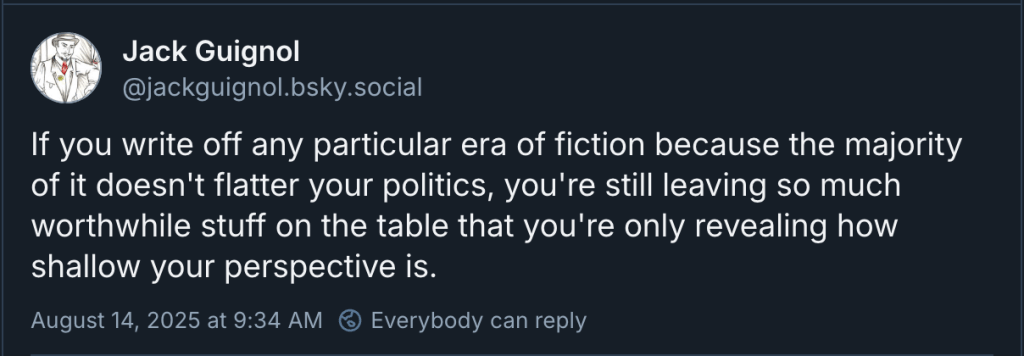
The other is from jackguignol also on bluesky, who is both a game designer and a professor of literature. He wrote this post about fiction, but I think it also applies to games. I don’t believe in writing off whole swathes of art because it doesn’t flatter your politics (one thing I have learned in reading more of the classics: old literature is more full of interesting women and queer people and people of color and disabled people than you know!). I recognize in a lot of ways that’s a position of privilege. But on the other hand, nearly every founder of Western thought didn’t think that women were “people”, and I have regardless found it possible to engage meaningfully with their philosophy, so. Grains of salt.
So I tie these two points together with an anecdote about The Price of Coal. A lot of people assumed that because of the historical setting – 1920s West Virginia – that all the characters would be straight white men. This is not true, because I did not want it to be true. For one thing, it is the historical reality that women were heavily involved in labor movements at that time; it was also the reality that Black and immigrant populations were a large part of the labor force in that time and place. And queer or gender nonconforming people have simply always existed, in ways you see and ways you don’t. It was a bad assumption. It was a bad reason to write off the game.
I had at least one session – one being more overt than others, but it still came up in others – where people asked me how they were supposed to roleplay as the elderly Black woman if they themselves were a middle-aged white man. Or how to play the immigrant father if they were a childless person who had never emigrated. Or how to play the gay man hiding his relationship if they were straight.
The answer I’m going to give sounds trite, but it is also true: you play them as a human. You play them as a person. If you think that these demographic differences make a character so entirely alien – moreso than a literal space alien from Pluto or a 1000-year-old elf – that you cannot understand how to roleplay as them, then there is a fundamental disconnect happening. (There IS a discussion worth having about doing so respectfully and without stereotypes, but a lot of that just starts from seeing them as people and not as flat archetypes). If you can imagine yourself as a hobbit in Middle Earth, why not as a musketeer in 1600s France (one of the examples given by the OP)?
Many, many years ago, my brother – who introduced me to RPGs when I was quite young – once let slip that he only put a female pre-generated character into his games if he knew that I or another female player would be at the table. To spite him, I just started refusing to take that lone female character and taking someone different. After all, I didn’t actually roleplay a man any differently than I roleplayed a woman. They might make different situational decisions, but it’s less than you might think. (He has since learned better! He doesn’t do this anymore! We evolve!)
(Sidebar: I think there’s a similar phenomenon with games like Bluebeard’s Bride, where you have to play a female character, and it makes me DREAD the release of my own games where you have to play women. I hate hearing men’s arguments about the reasons they don’t want to or can’t or shouldn’t play female characters, or run this game in particular. Especially in home games, not even with the added wrinkle of streaming for an audience! With love: grow the fuck up.)
So putting this all together, I think there’s a gulf people are inventing for themselves where they don’t want to play historical RPGs because they think the characters will be intrinsically too alien or too hard to understand or too easy to get wrong, despite being objectively much more similar to them than something more fantastical (and in fact, forcing them to confront their similarities to other people is part of the point). Another dead horse I’ve beaten into the ground when talking about history, and not just historical games, is this: people have always been people. This requires balance with the mindset that people really did and do have different ways of life and modes of thought, bringing this back to the start, but I want to trust people to hold two different thoughts in their head at the same time.
My final point here for why historical RPGs don’t tend to see mass adoption is one that I’ve made before, way back last summer. Last year, I talked about how RPGs are a great tool for practicing vulnerability, because intrinsically, playing RPGs with other people requires a degree of vulnerability. To build on that, I think historical RPGs require additional vulnerability even on top of what other games do, and in particular areas that we tend to punish people.
In most games, it takes vulnerability to do things like “speak as your character in the first person” or “venture a plan that everyone else might think is stupid”. But that’s just in a “making things up” game. In a historical game, there’s very real grounding to it. To come back to that point I made initially about not wanting to be corrected or do things wrong, I think this is – often, but not always – an unexpressed vulnerability.
Getting something wrong – like actually factually wrong – requires vulnerability, because it is often punished in children, or corrected in really unconstructive ways. This is why people in early Price of Coal playtests would ask for things like price sheets at the company store or a map of a real town in West Virginia. Because even when I told them “just make something up, it doesn’t really matter for this scene”, the possibility of being wrong was much harder for them to face than it might have been in a game where the whole thing was just made up, and they couldn’t or wouldn’t do it.
This relates to the previous point, too, where it requires vulnerability to put yourself in a position where someone might correct you on your portrayal of a group you don’t belong to. I do think that most of this is averted by a really basic understanding of respect and avoiding stereotypes, but again, if someone can say “hey Jen, your portrayal of an immigrant is not working for me here” and I have to say “hey, thanks for letting me know, I’m sorry about that, I’ll do better”, that’s a real vulnerability in a society that has a lot of very particular ideas about apologies and weakness and transgression and, again, punishment.
Both of these get back to ideas about shame (people have literal nightmares about this!), which is a really powerful demotivator, and about resilience and stability, which are foundational to being able to put yourself in vulnerable positions – even minor ones, even among friends in a game of play-pretend. Some people either do not have the reserves of resilience and emotional stability to fulfill the higher asks of a historical RPG, or they don’t want to spend them on that, and I can’t really fault either case. For whatever it’s worth, I talk a lot about how this type of game – historical games, tragedy games, etc – asks a lot of players, but I also think they’re really rewarding. Every time I run The Price of Coal, I make a point of thanking my players for giving so much of themselves to it, and I hope it rewards them in return. (Ben Robbins has a great blog post about “a satisfying game” you should check out)
So anyway, after all that, I think these are additional reasons that historical RPGs don’t see wider adoption that people are unlikely to state themselves, even when they are true. I don’t think they’re universally true, and I think a lot of it is often subconscious. But those are all thoughts I had that I wanted to put HERE and not on social media because I don’t need randos getting mad that I said they were too illiterate and too psychologically fragile to play my cool game.
NOTE 1) As a post-postscript, to preempt the question: “Jen, how do you know when someone is being an unwilling coward vs when someone is simply not psychologically available for certain kinds of play due to factors in their life?” You don’t! I don’t! That’s why we have to be nice to everyone! Be nicer than me! Don’t BUG people about it even if you suspect them of being a lily-livered little chump! Let them read your unaddressed words and decide if it resonates with them!
NOTE 2) As ANOTHER postscript (my god, what have I done), after writing this section, I was describing this whole thing to my dad and he gave additional thoughts, albeit somewhat boomer-inflected. He brought up the fact that people don’t sing together anymore. My grandma, his mother, was a music teacher, and she used to say that people would hang out around the piano and sing songs together after an evening of drinks and card games and stuff, and that singing together is the ultimate icebreaker, but people don’t do it anymore because normal people don’t sound like professional singers. I had not connected this with the fear of not being good at something right away, which is very common and which I did talk about before in the “beginner RPG” screed. But that’s also true! It’s one more layer of “a thing I might not be good at”. Then again, I also didn’t tell my dad about karaoke. Maybe the solution is more karaoke bars everywhere.
My brother was there too, who also works in games and had been describing the resistance he faces when trying to get people to play anything other than the very biggest names in the industry, as we are all familiar with. There’s also a layer of this that a historically grounded game is often MORE unfamiliar than something more fantastical, despite being based in the actual reality we actually live in. There’s fewer media references for it, and typically quite different mechanics from, say, 5e. People want what they know, as every indie RPG designer already knows. Stack on a little multiplier for historical games, maybe.
NOTE 3) My god… a third postscript has hit the newsletter… There’s also a note here that a historical game is often much more overtly political and overtly making a statement than other games. All games are political, intrinsically. But it’s a lot easier to choose to ignore the politics in the make-believe lands. And as I openly admit, I choose the historical setting for my work because I have something to say about it. I’m preachy, I’m a whole lecturer. And some people just don’t want to hear it. Not YOU, though, that’s why you’re here.
Prototyping for Playtest Value
Okay, that section was so long that it probably feels like days ago when I talked about the prototyping I was doing for Pax Deorum, way back in the first section! So, let’s talk a little about what that entailed and why I did it and what I got from it.
Pax Deorum is a game that involves a lot of clock management (stealing clocks from games like Apocalypse World and Blades in the Dark but making them a lot more the central focus of the thing). At certain points when clocks fill up or people run out of ways to manage the clock, various story events happen. Clocks fill up some amount (determined by dice) each round, and then players have to spend their turns taking pressure off of the situations represented by those clocks (this is an RPG, not a board game, so their turns are also scenes, their character sheets have scene prompts that also tell them which clocks they can alleviate, you don’t need to know all this yet probably).
What I wanted, before I put this in front of other human beings and wasted their time with it, was to get a better handle on the math here, with the number of clock segments (some are 4, some are 6, some are 8), the dice involved (d4, d6, d8), and how many rounds pass before things happen or between events. I think it is probable I could have done SOME of this with probability-based extrapolation – the averages of dice rolls, etc.
But that isn’t what I’m good at and that isn’t what I did. What I did was I sat down at my dining room table with a big fat stack of index cards and my notebook, drew all the clocks in sharpie marker (this is going to be a TERRIBLE dementia test when I’m older, I’ll tell you that much) and… sort of played the game six times. Each time I controlled for different variables – which dice I was rolling, how many actions the player characters had, other little procedural elements that won’t make sense without me showing you the whole damn thing). And I wrote everything down.
Obviously I didn’t play out the scenes by myself, but I pretended to have such and such characters in front of me, and I wrote down what actions they did and I messed with the clocks accordingly, and I made note of how many rounds everything was taking to reach certain boiling points, from which I am roughly extrapolating how long the game will take (for example, The Price of Coal has decently-lengthy set-up process and then between 16 and 20 scenes of play, and takes about 4 hours total).
From these prototype tests, I figured out a few different ways I could approach things and ways to tweak the pacing that I don’t think I would have had otherwise (do I want to create a big unstoppable snowball of terrible things happening? Do I want to give you little breaks of catharsis in between? Do I want a slow build or to get things really rolling right away?). And it also forced me to answer some questions that I simply hadn’t really thought about (what if the d8 NEVER rolls an 8, the whole game? What if a clock is already full when you roll to add to it again?). Fortunately, the biggest benefit of these prototypes was as a really solid proof of concept. I convinced myself the core system would work, with some adjustments, which wasn’t a sure thing before.
And crucially, I did all that without having to go through the whole hassle of scheduling time with people to come over and playtest, or having to have every scene prompt or character description already written for someone else to use and understand. I didn’t waste anyone’s time bringing something I hadn’t really thought about to the table (except my own, and I wouldn’t consider that a waste).
We talk a lot about “playtest as early as possible” in this space, and I’ve been pretty open about disagreeing with that. I playtest pretty late in the process, when I’ve already got certain things pretty ironed out. …unless you count these prototypes. Those, I do quite early (I have done them for other games, even if I never had to do so many in such a short period of time). That’s a kind of playtest too, even though it doesn’t involve other people.
I think the addendum I need to offer for my previous statements against early playtesting is that I really hate wasting other people’s time. I want to put a game in front of them when I have something to show them and when I can get the most value out of their feedback. In this case, now that I know different ways that I can tweak the pacing of the game, I can intentionally try those different methods with actual people at the table and see what they say about it, with an understanding of why that’s happening and how to change it if I want to.
If I had brought the version of the game that existed before the first couple prototypes to a real playtest with other people, we would have fairly quickly run into some pretty obstructive walls that I didn’t realize were there. Then we would have wasted a bunch of time while figuring out how to work around it or what to do or if we should start over, and given the difficulty of scheduling (the final boss of tabletop gaming, etc etc), I think I would hate that. Doing it this way let me hit those barriers, go pace around my backyard for a while, then come back to it later with a clearer approach.
So that took up a good chunk of time this month, but I am glad that I did it (and I think it has also made me feel more confident about making more mechanically complex games! Not that Pax Deorum is anything particularly crunchy, but it IS more than “questions on cards”, you know).
Influences, Bibliographies, Citations, and Appendix N
Whew okay, maybe we’ll make this a quick one, because I pushed it out from a couple of past months (it’s an evergreen topic) but I DO want to make sure I get around to it. Citing our sources and our artistic influences! It’s an important thing to do!
Maybe it actually is good that this came up this month, because one of the things I did this month was compile all of my research for Pax Deorum (a process that took several years, on and off), and make a proper bibliography – I’m a little self-conscious about where I’m having to “invent” to fill in gaps in the historical record, and I want to show that if nothing else, I did the best I could to make sure what I had to “invent” is still pretty grounded and based in real research. I didn’t include a bibliography for The Price of Coal, but I easily could have if we’d had the space, and I could probably put it up on my website now, really.
I’ve joked before that “thoroughly researched” is not really a huge selling point for RPGs, but it is, regardless, something that’s important to me to do right. For one thing, it patches up my ego about being a failed academic. For another thing, it is simply ethically correct to cite your research. But what about games that don’t have that kind of historical or material “research”, what about citing influences?
You may already be familiar with “Appendix N”, which is Gary Gygax’s list of books and authors that influenced the earliest editions of D&D (this is still something they do, or at least did up to 5e. Do the 5.5e books have the media inspirations page?). It doesn’t have to just be books, although the original Appendix N was. In Dollhouse Drama, I included a whole page of media references, including toys, cartoons, movies, and music. I love when games include this, not even just for ethical reasons, but because it gives me a wealth of touchpoints for when I’m playing or running the game, material to draw from if I need a quick idea or want to make sure something tonally fits.
So far, so good!
Where I think we still have a ways to go is citing other RPGs that we’ve used as inspiration (mechanically or tonally). For things where you’re making a direct hack of another game, there is often a way to notate that (for example, games that hack Apocalypse World are called “Powered by the Apocalypse” games) and a correct method of crediting it. What’s trickier is in the way that game mechanics change and evolve in different iterations, or where we pull together mechanics from entirely disparate games to make something new.
Generally I think it’s good to be upfront about this! Like I don’t mind saying that The Price of Coal borrowed mechanically from For the Queen, The Quiet Year, Heaven’s Collapse, and Montsegur 1244. I like doing that, because I also love those games, that’s why I was inspired by them, and I want more people to go and play those games too. And it makes sense, because if someone liked The Price of Coal, I think there’s decent odds they’ll like at least one of those games, maybe all of them!
What I think is hard is the idea of saying that something was “first” – like, For the Queen is not the first game to involve asking pointed questions on cards, but I would have absolutely no idea what WAS first. My train of thought is that I should cite what I actually used, which was FtQ, and not some other game that I have no idea about but that was released first and used a mechanically similar idea.
It actually really bugs me when I see crowdfunding campaigns or marketing for games coming out right now that insist that they’re the first to do something extremely basic, that shows they don’t really understand the current state of games in a way that borders on disrespect. I don’t think I’ll ever claim that one of my games is the first to do ANYTHING because there’s 50 years of RPG history that I have frankly very little insight into, and how could I possibly know? I am very much of the “I stand on the shoulders of giants” mindset, creatively.
And all of this gets a little tangly with the fact that game mechanics are not (at the time of writing) able to be copyrighted. You can copyright the words you use to describe them, but not the mechanic itself (if you ever wonder why some board or card games describe “turning a card sideways to indicate it’s been used”, it’s because Wizards of the Coast trademarked the term “tapping” that they used for Magic). So all of this is being done on the honor system, and if someone DOES use your game’s system or mechanics but doesn’t cite your game anywhere, there’s really nothing you can do about it (even besides the fact that hardly anyone in RPGs has lawyer-money, except Hasbro themselves). There have been instances of direct plagiarism, where actual sections of text and writing were stolen, but that’s much more clear-cut than this.
I usually compare it to the golden age of sampling in hip-hop. We’re all small artists remixing and reworking and recutting each other’s work in ways that are creatively inspiring and innovative, and often we’re just pleased to have had some kind of influence or to have been seen. But years later, after any number of lawsuits and the streaming era necessitating the sorting out of “who actually owns what” (this is why De La Soul’s music wasn’t on streaming until last year!), we’ve landed in a place where labels are actually proactively giving a credit to something they DIDN’T use just because it sounds similar and they don’t want to risk pissing off someone litigious.
I don’t want that to happen to us in RPGs. I don’t want us to get litigious. I understand the need to protect your intellectual property, but I think if we land in a place where people are no longer able to creatively “sample” or remix or, as we usually call it, hack each other’s work without extensive legal clearances, I think we will be poorer for that as a creative space. But then again, so much would need to change for this to even be feasible (for one thing, we’d all need to start making a lot more money!) that it probably isn’t a realistic fear at this point.
The last thing I kind of wonder about ethically and still have not found satisfaction with is citing “negative” influences. Sometimes I have a really dissatisfying experience with a game, and in my own work later, one thing I am trying to do is deliver a better version of that experience. So far, I have landed on the side of still listing that game as an influence, putting it in the mediography, etc. I think that’s still the right thing to do. And then if called on to talk about it, I can be polite about it, but I don’t actually need to explain “I didn’t like this” unprompted. After all, someone might still discover that game from my reference, and they may end up loving it! My taste is not the final arbiter of quality! But man, I still feel bad even thinking about it sometimes. Maybe that’s a me-problem.
Closing Notes
I’ve been thinking a lot about Joan of Arc lately. This isn’t terribly uncommon for me – I’m always on my lady knight bullshit, after all, and this is just one form of it. Joan mania comes and goes in waves. I keep thinking about how I would do an interesting Joan of Arc RPG, which feels almost like an inevitability for me to try rather than “an idea” that I have “had”. It’s hard to do a game about one person. It’s certainly not impossible, and there’s certainly examples of how to do it well, but I don’t know that I feel any of my existing models for it would fit. You could take a Companion’s Tale type approach, much like Mark Twain’s Personal Recollections of Joan of Arc, a novel about her that is written as though it’s by her squire and companion. You COULD do lots of things! I don’t know! It’s something I keep rotating in my mind, though.
Anyway! Go buy my games on sale this month! Sale will be over when the next newsletter comes out, so don’t forget!
 Owl Knight Games